

Key takeaways:
- FME Flow Hosted is the cloud-managed version of FME Flow, offering full FME Flow functionality with no infrastructure management overhead.
- Safe Software handles the administrative and operational work, including OS patching, vulnerability monitoring, and scaling and maintenance of the underlying infrastructure.
- Enterprise-level security is achieved via shared responsibility with AWS and architectural choices.
- Cut costs by scheduling, right-sizing, and API-driven automation.
- Flexible pricing fits any usage pattern, from pay-by-the-hour trials to annual plans and bundled enterprise subscriptions.
FME Flow Hosted is the cloud-managed version of FME Flow, running on AWS infrastructure that Safe Software manages on your behalf. It gives you the full FME Flow experience without the infrastructure headache. Safe Software handles the machines, networking, patching, and security perimeter, while you handle the data work.
The top reasons people choose to host FME Flow in the cloud include:
- No infrastructure management
- Scalability
- Flexible deployment
- Secure and reliable
This blog discusses 5 benefits and real-world use cases for FME Flow Hosted. For a deep dive and live demos, watch our webinar, 5 Must-Know Use Cases for FME Flow Hosted.
Use Case 1: Innovating and Prototyping at High Speed
An amazing thing about FME Flow Hosted is how fast you can go from an idea to a running server. Just set some parameters (such as the region and instance size), hit Launch, and wait 5-7 minutes for the FME Flow instance to spin up.
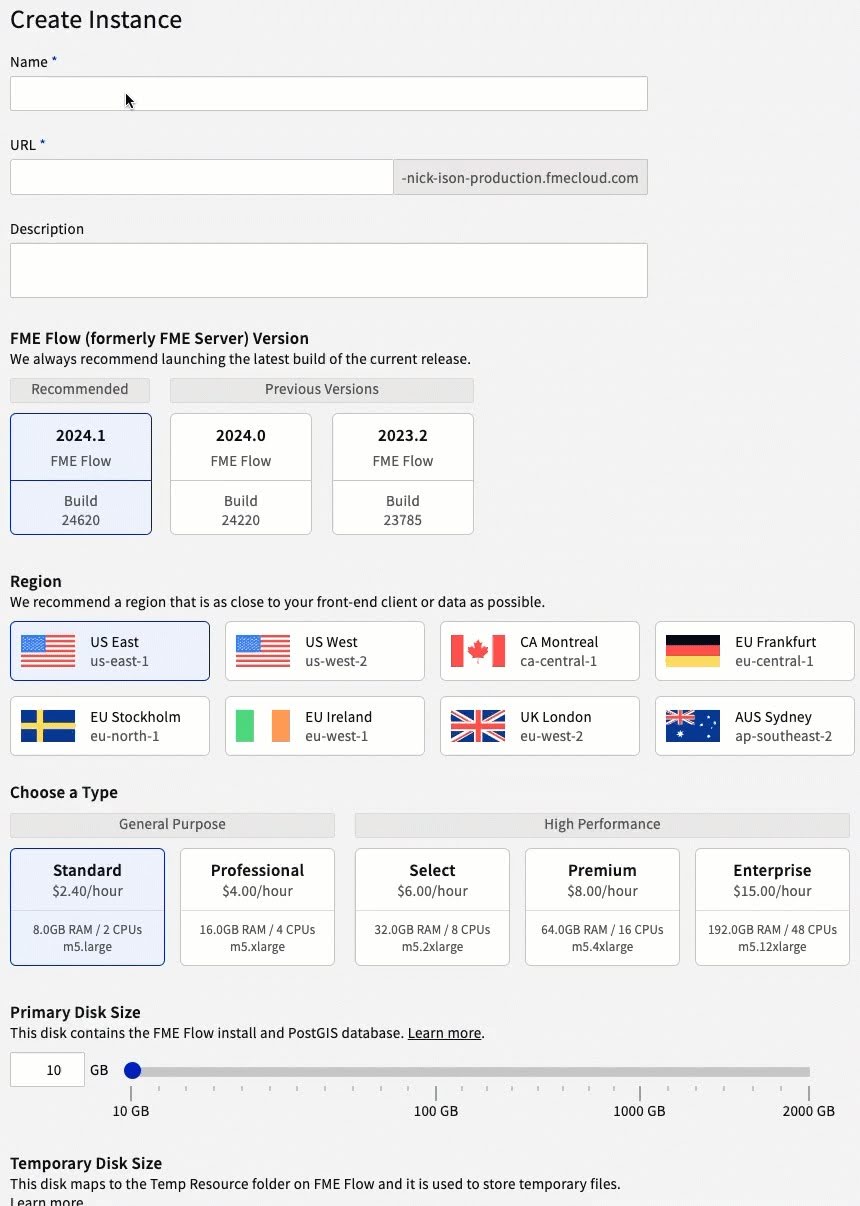
This speed is useful for proof-of-concept work. In addition, because instances are isolated from your main infrastructure, experimenting carries no risk to production.
Real-world example: PlanView Utility Services built a permit-evaluation platform that automates 95% of tickets, so work that took 15-20 days of GIS analysts searching databases now happens in minutes.
Use Case 2: Offloading Maintenance
When you use FME Flow Hosted, Safe Software handles the administrative and operational work, including OS patching, vulnerability monitoring, and scaling and maintenance of the underlying infrastructure. FME Flow Hosted also takes automatic backups every 24 hours and on every instance start/restart.
This backend management frees you to focus on higher-level tasks. For example, can build custom alerts on metrics like memory or engine count, which can be delivered via email, Slack channels, or Webhooks (Zendesk, ticketing systems, etc.).
Real-world example: Cochranville Ag Service integrated Salesforce and FME Flow Hosted, enabling users to generate Excel reports of crop rotation data directly in Salesforce.
Use Case 3: Security Through Shared Responsibility
Security for FME Flow Hosted splits across three parties:
- AWS: physical data center security, networking, redundancy, compliance with hundreds of international standards.
- Safe Software: OS management, vulnerability identification, patching, secure-by-design platform architecture.
- You: access control and FME Flow’s own security configuration.
A few architectural choices worth understanding:
- Single-tenancy model: every instance runs on its own dedicated machine. No shared filesystems means no risk of cross-customer data exposure.
- Encryption at rest and in transit: all stored data is encrypted; SSL handles transport.
- Continuous security work: ongoing vulnerability monitoring, annual risk assessments, regular penetration testing.
You also get your own controls, such as IP whitelisting to limit access to specific addresses or ranges, and port-level controls to open or block ports as needed.
For OS patching, you choose the cadence. You can let updates happen behind the scenes, schedule a 2 a.m. reboot, or trigger them immediately.
Real-world example: Tessera Systems uses FME Flow Hosted with the Insurance Bureau of Canada to process data in Amazon S3. Amazon’s notification mechanisms trigger FME workflows whenever data changes, identifying high-risk areas in near real-time. The tight AWS integration makes this kind of architecture clean to build.
Use Case 4: Saving Money Through Smart Resource Management
FME Flow Hosted gives you several levers to align spend with actual usage rather than peak provisioning:
- Monitoring. Built-in dashboards show RAM and server load over time. Right-sizing decisions become concrete. For example, if you find that you’re well below your limit regularly, you can downsize, or if you’re hitting your limit regularly, you know it’s time to increase the size.
- Scheduling. On pay-as-you-go plans, you can automatically start and stop your instance. For example, you can run it only during working hours, or during a nightly batch job between 2 AM and 4 AM.
- The API. Every UI action is available through the REST API: create instances, start/stop them, resize them, manage backups.
This opens up event-driven architectures. For example, a script watches an S3 bucket or Dropbox folder for new data, starts your instance if needed, queues the job, runs the workspace, and shuts down at the end. Pro tip: have your final workspace trigger the shutdown itself, as this is more reliable than estimating run time.
Real-world example: Arkansas GIS Office migrated 7+ TB of data and now runs their entire open data portal on FME Flow Hosted. The result is 74% savings over three years, totaling hundreds of thousands of dollars.
Licenses through FME Flow Hosted include unlimited engines for concurrent jobs. Practical limits depend on instance size, but you can scale engines up or down via API based on workload type. For example, web-service-heavy workflows benefit from more engines (lots of waiting on responses), whereas raster, lidar, and CPU-bound work benefits from fewer, more resourced engines.
Use Case 5: Pricing That Matches How You Work
Three pricing models, each fitting a different usage pattern:
| Model | Best for |
|---|---|
| Pay-by-the-hour | Intermittent workloads, batch jobs, proof-of-concept work |
| Annual plans | Continuous 24/7 usage — significant savings over hourly |
| FME Enterprise subscription | Organizations with broader FME footprints (bundles Flow, Form, and Flow Hosted) |
Enterprise subscriptions are particularly flexible, and you can shift capacity between Flow, Flow Hosted, and Form without re-procuring. Billing flows through the subscription, and a monthly credit (sized to your instance) covers on-demand costs like data transfer.
There’s also Safe Software’s partner network: partners worldwide can implement solutions, and many will manage FME Flow Hosted instances on your behalf.
Getting Started
FME Flow Hosted lets you spend your time on data work rather than infrastructure work. If you’re ready to get started, sign up for an FME Flow Hosted account here to launch your first instance.
Safe Software offers a $250 trial credit, which is enough for a couple of hours a day for a few weeks on an entry-level instance. Start with or without a credit card, spin up an environment within minutes, experiment with the credit, and see if it fits.
Learn more: