Understanding complex GIS environments
For GIS administrators, understanding how data moves across an organization isn’t always straightforward.
A single ArcGIS service might support multiple web applications. An FME workspace may feed several downstream systems. Over time, new workflows are added, dependencies grow, and the connections between systems become increasingly difficult to trace. When something changes or breaks, understanding the impact can take hours of investigation.
That challenge inspired Kieran O’Donnell to create Ripple.
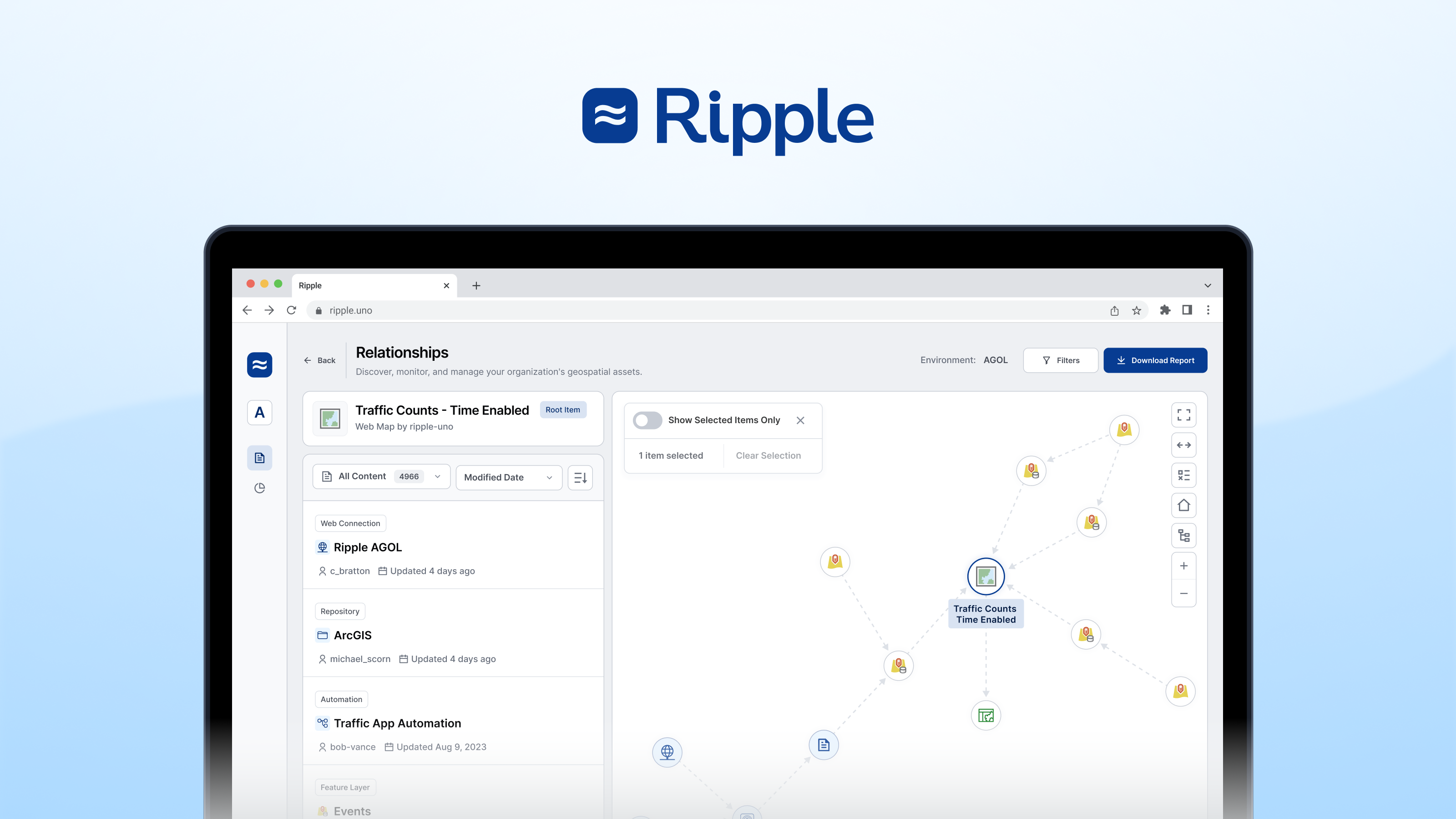
Built on FME, Ripple helps organizations visualize the relationships between their FME and ArcGIS environments. The platform gives GIS teams a clearer understanding of how data, workflows, applications, and automations connect.
However, while Ripple solved an important problem, O’Donnell believed the platform could do much more.
See Ripple in action and how it helps GIS teams explore relationships across FME and ArcGIS environments.
Pushing beyond the original architecture
Ripple’s first release focused on helping organizations understand their ArcGIS environments. Built using FME Flow, webhooks, and configurable applications, it automatically generated reports that revealed relationships between content, users, and applications.
The solution proved its value with customers, but it also highlighted the limits of the original architecture.
Reports opened in separate browser windows, interactions were constrained by the application framework, and expanding the platform meant introducing additional infrastructure.
“We’d built something that worked really well for the limitations we had,” says O’Donnell. “But we always wanted an application that didn’t require a complete backend.”
To move beyond those limitations, Ripple needed an architecture that could support the platform it had envisioned from the beginning.
Finding the missing piece
When FME Data Virtualization was introduced, O’Donnell immediately recognized the opportunity.
“When I saw Data Virtualization come out, I thought, ‘This is exactly what I’ve been looking for.’ It enabled us to build the platform that we always wanted to, and we always knew was possible, without needing a backend.”
Instead of relying on webhooks and report generation, Ripple rebuilt its platform around Data Virtualization.
Today, FME Flow serves information directly to the application as users interact with it. Rather than generating static reports, Ripple delivers information on demand, allowing users to navigate relationships across their GIS environment from a single application. FME Flow also handles the backend services and authentication, eliminating the need for separate infrastructure.
Seeing how everything connects
As Ripple evolved, so did its scope.
Originally designed around ArcGIS, the platform now helps organizations understand relationships across both FME and ArcGIS. It traces connections between FME workspaces, readers, writers, automations, ArcGIS services, web applications, users, and groups. This gives GIS teams a clearer picture of how information moves throughout their organization.
Rather than manually searching across multiple systems, administrators can quickly understand where data originates, how it flows, and what downstream applications or workflows may be affected by a change.
“If something is being referenced inside a web application that’s getting thousands of hits a day, you need to know who’s going to be impacted if something breaks,” says O’Donnell.
Keeping data where it belongs
For many organizations, visibility into their GIS environment must be balanced with security.
Because Ripple is built on FME Data Virtualization, organizations can explore relationships across their environments without moving data into another platform. Data remains within each customer’s own environment while the application serves only the information users request.
“Data stays completely within the customer’s own environment because everything runs inside FME. It becomes part of the trusted platform they’re already using to process their data.”
Organizations using Active Directory authentication with FME Flow can also extend that same authentication into Ripple, reducing administrative overhead without introducing additional user accounts.
Simple to deploy, easier to grow
Ripple is delivered as an FME Project that customers import directly into their existing FME Flow environment.
“We just export an FME Project file that customers import into FME Flow, and they’re ready to start working with Ripple,” says O’Donnell. “You’re deploying a complete application backend by simply sending a file.”
This deployment model allows organizations to get up and running quickly using the FME infrastructure they already have in place, while making future updates and enhancements easier to deliver as the platform continues to evolve.
Looking ahead
Rebuilding the platform with FME Data Virtualization didn’t simply improve Ripple’s user experience. It fundamentally expanded what the team could build.
With FME Flow now providing the backend, Ripple has introduced new reporting capabilities that weren’t possible with its original architecture and continues to expand the platform’s functionality. Looking ahead, O’Donnell also sees opportunities to incorporate emerging capabilities such as FME MCP. This will enable new ways for users to interact with the platform as customers adopt newer versions of FME.