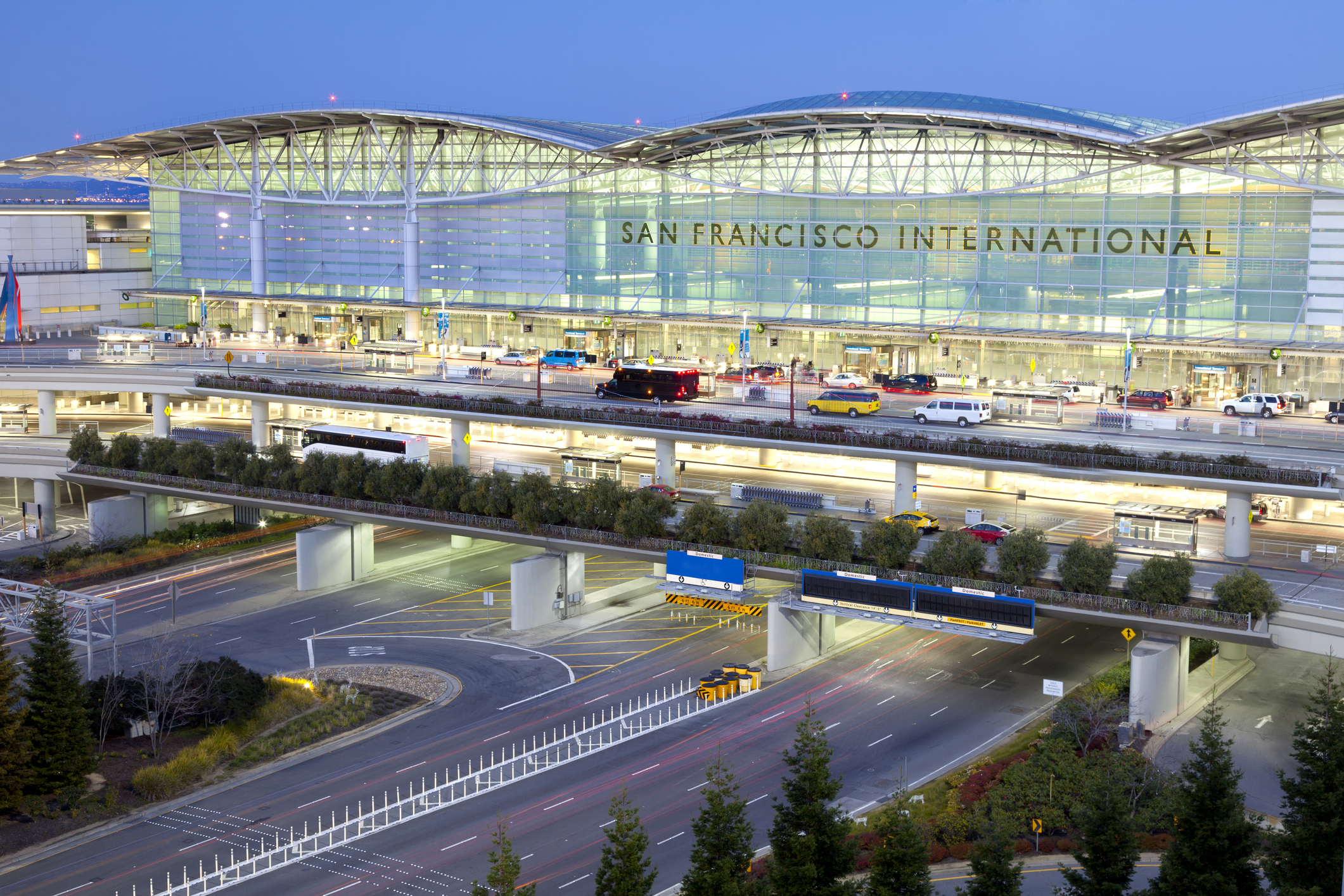
The views expressed are those of the interviewee and do not constitute an endorsement by San Francisco International Airport.
Supporting airport-wide needs through centralized data workflows
At San Francisco International Airport (SFO), location data underpins virtually every aspect of airport operations—from the location of infrastructure assets to real-time insights into parking availability and passenger movement. With so many assets across the campus and multiple business systems, maintaining a centralized and synchronized GIS environment is no small feat.
“We’re tasked with any GIS need that the airport could have for any stakeholder around the campus,” explains Aric Lang, GIS Analyst at SFO. “Whether that’s maintaining the data, hosting web applications, or generating paper maps—whatever people need, we field their requests and work from there.”
Lang is one of just three analysts on SFO’s primary GIS team—a small group responsible for serving GIS needs across one of the busiest international airports in North America. The scale of what this team manages, from thousands of infrastructure assets to live operational feeds, underscores just how much automation and repeatable workflows matter.
At the heart of this work is infrastructure data. From utilities to floor plans and outdoor assets, the team is responsible for keeping this information current and accessible. This foundation supports both day-to-day operations and SFO’s evolving digital twin—a system that merges infrastructure data with live operational insights to provide a unified view of airport activity.
The push to build out this operational layer came with the development of SFO’s Integrated Operations Center (IOC). Decision-makers in the IOC needed to visualize passenger experience elements—checkpoint wait times, terminal congestion, gate activity—on top of the existing infrastructure map. That meant bringing together data from a broad range of business systems into a single, coherent view. The GIS team was at the center of making that possible.
Using FME to manage multi-stage environments and complex data
Maintaining accurate data across multiple environments—editing, staging, and production—was once a manual and time-consuming process. With FME, the SFO team has automated key stages of this workflow. FME also handles the abstraction of source data arriving in formats like CAD and BIM, converting it into GIS-ready formats without manual transformation steps. These automated transfers minimize manual intervention and ensure stakeholders can always access the latest and most reliable data.
Bridging the gap between systems with API integration
Beyond internal systems, the airport relies on a number of external business platforms, each with its own data structure. Integrating these sources with the GIS environment is a complex task, but FME helps bridge the gap.
“We’re able to take all these different APIs, which are coming from different business systems, and standardize field names and how the attributes are structured,” Aric explains. “Then we can get that into the same format we use and join all of this other information so it can be visualized together.”
A key part of this is that the team can build and maintain these integrations without writing custom code. FME’s low-code environment means the team can connect to live data sources—flight schedules, checkpoint wait times, parking occupancy—and configure how that data is shaped and joined, all without needing to hard-code each integration from scratch. For a small team managing a complex, ever-changing data environment, that flexibility is significant.
This harmonization enables the team to overlay operational feeds—like flight schedules, checkpoint wait times, or parking availability—on top of existing infrastructure maps. The result is a more complete picture of what’s happening at the airport, all in one place.
Scaling to meet the demands of a complex campus
Managing a major international airport comes with unique data challenges. Without automation and scalable data processes, delivering up-to-date information to dozens of internal stakeholders would be a massive lift. But with centralized tools and repeatable workflows, the team is able to respond to a variety of needs quickly and accurately.
One example is the sheer number of infrastructure components the team tracks, which includes over 15,000 doors across the SFO campus. A locksmith assigned to door maintenance can now easily search for and view the most up-to-date location information they require.
How the GIS team is building for what’s next
As SFO continues to evolve its digital twin and integrate more real-time insights, the work the GIS team has done to connect and automate these data pipelines will continue to support that growth.Whether it’s streamlining updates, connecting external systems, or helping a department find the right data at the right time, the GIS team is making it all possible.
The data infrastructure the GIS team has built—and continues to refine—flows all the way through to every passenger moving through SFO. When a traveler checks a wait time board, finds their gate, or pulls into a parking garage, they’re benefitting from the same connected data environment powering the airport behind the scenes. That isn’t a side effect of the GIS team’s work — it’s the whole point.