FME with MCP. The Power of Choice, Expanded.

Bridge your data with any AI.
From spatial data to enterprise workflows, organizations across industries are adding MCP interfaces to their systems to unlock new possibilities. FME with MCP enables you to connect your data to more AI agent technology than ever before.
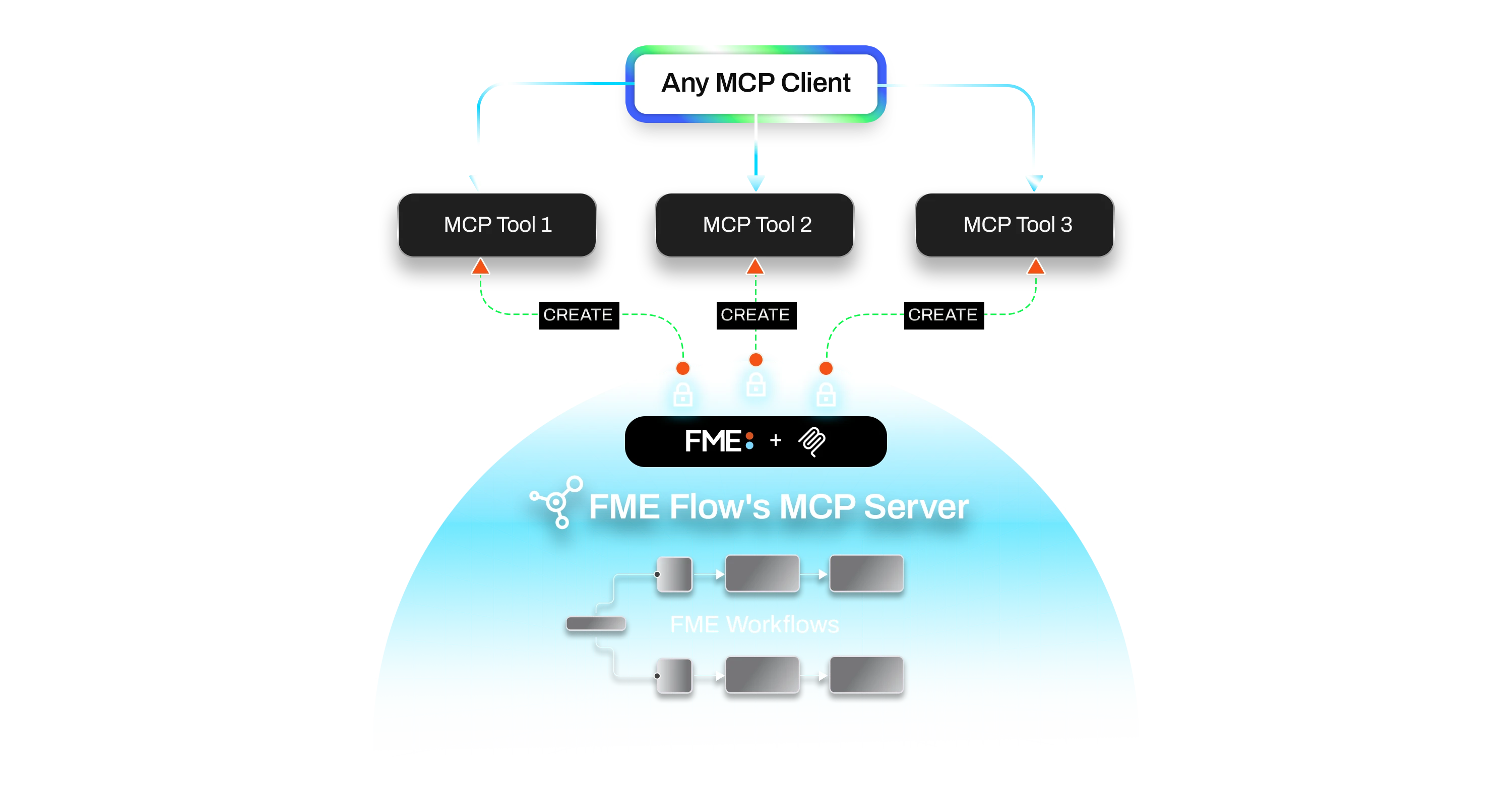
Benefits
Freedom to Choose Any AI
Trusted by Design
Enterprise Integration Expanded
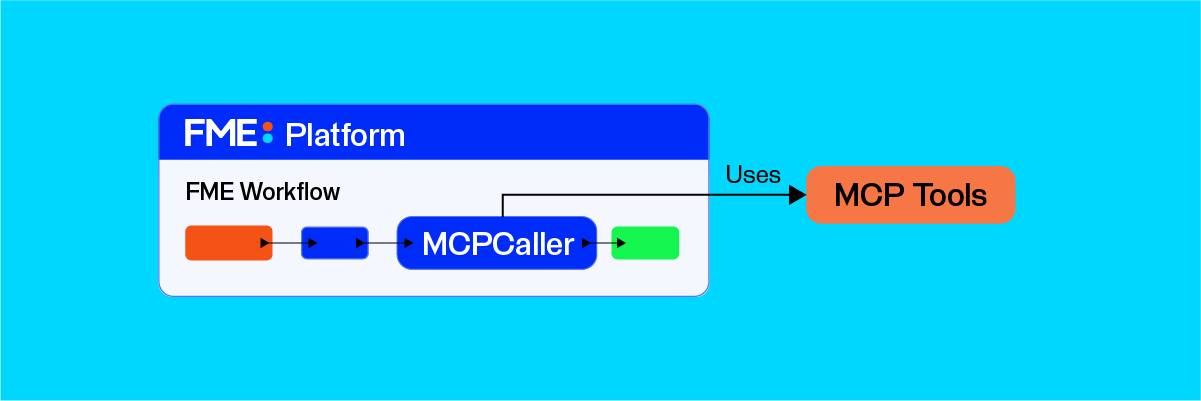
MCPCaller Transformer
Design-Time (Deterministic)
Run-Time (Dynamic)
Unified Schema
Adaptive Error Handling
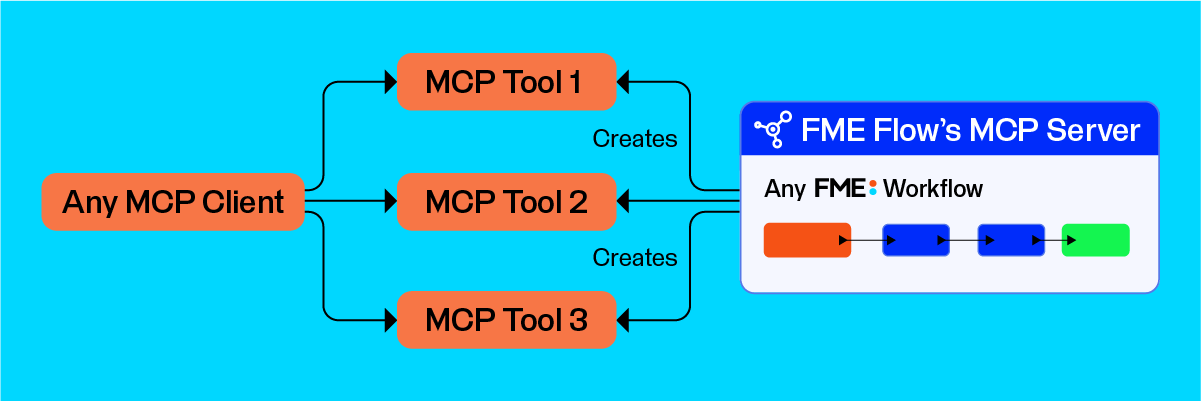
MCP Server and Tool Registry
Easy Tool Creation
Value from Day One
Enterprise Secure
Universal Discovery
Discover how FME with MCP could work for you.

Public Sector
Challenge: Government agencies face overwhelming citizen inquiries and growing backlogs for permits, zoning, and service requests.
Solution: FME Flow’s MCP Server securely exposes approved government systems and policy data through governed, access controlled endpoints.
Benefits: Agencies can provide 24/7 support without exposing sensitive data, ensure requests receive accurate information, and reduce the manual workload placed on GIS and IT teams.

Utilities & Energy
Challenge: Utilities must respond quickly to outages and asset failures, but critical information is spread across GIS, asset management, SCADA, and maintenance systems, making it difficult to get a complete, reliable picture when time is critical.
Solution: FME workflows use the MCPCaller to invoke approved MCP tools that retrieve and validate asset registry, work order, IoT, and compliance data in real time.
Benefits: Teams can reduce manual data lookups across systems and answer operational questions quickly using trusted, up-to-date information.

Transportation
Challenge: Transportation agencies coordinate construction activities and traffic impacts, but fragmented data across systems makes it difficult to answer operational questions quickly.
Solution: FME Flow’s MCP Server exposes new OAuth 2.0-protected MCP tools that retrieve construction schedules, query asset inventories, and assess traffic impacts across systems, providing a consistent and authoritative operational view.
Benefits: Teams can understand construction and incident impacts faster, reduce manual data compilation, and provide accurate information to internal teams and the public.
Frequently Asked Questions
FME with MCP makes it easy to give AI agents secure, controlled access to your systems and data. Instead of building custom integrations or relying on stale training data, models can interact directly with your APIs, services, and workflows, accelerating time-to-value while staying governed and predictable.
By running an MCP server, you explicitly define what an AI can do in your environment—whether it’s to retrieve data, trigger actions, or run searches. This extends the model’s capabilities safely without any guesswork or hallucinations, because the AI only operates within the boundaries you’ve set.
Traditional function calling and tool integrations are typically built directly into an application and tied to a specific AI model or provider. These work well for single use cases, but they don’t scale as easily across multiple AI models, applications, or environments.
FME with MCP standardizes this integration layer by securely exposing workflows, data, and tools in a way any AI model can understand. This allows organizations to connect any AI to any system without vendor lock-in and without code, and to reuse those capabilities across models as technology evolves.
MCP capabilities are now available in FME. The MCPCaller Transformer is available in FME 2026.1+, and FME Flow as an MCP Server is available in FME 2026.2.
FME with MCP will be included at no additional cost for customers with FME Form and FME Flow.